New product ideas have little room for error. With early-stage startup funding and deals dwindling since 2022, securing investment into a brand-new product is no cakewalk. Besides, failing to validate product-market fit is also the second most common reason why startups fail.
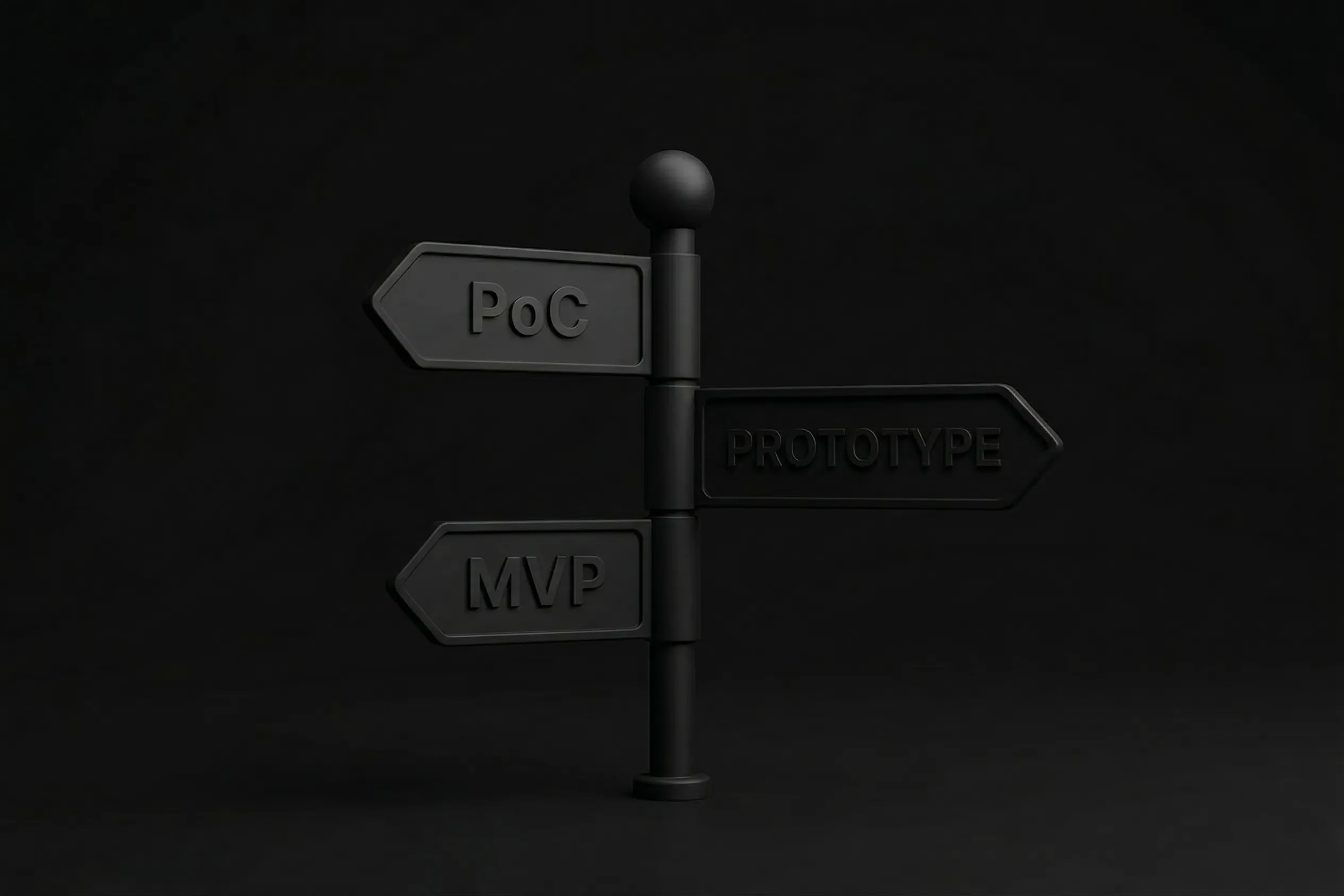
Proofs of concept, prototypes, and MVPs are all destined to help turn your idea into an actual product. But each serves its own purpose and has distinct pros and cons. Let’s break them down in our PoC vs MVP vs prototype comparison guide for founders and business owners.
TL;DR
A proof of concept (PoC) is a small-scale demonstration meant to verify technical feasibility or compare different technical approaches.
A prototype is the product’s interactive replica created to test and validate UI/UX flows.
A minimum viable product (MVP) is a simplified, ready-for-launch version of the product used to validate real-world product-market fit.
PoC vs Prototype vs MVP: Let’s Define Each
Any good PoC vs MVP vs prototype comparison guide starts with clear definitions. Here are ours:
Prototypes are interactive visual representations of the product. They give an idea of how the product will look and behave, without any actual working functionality under the hood.
Proofs of concept (PoCs) refer to anything that proves your product’s functionality can work at all. Think of PoCs as small-scale demonstrations that say: “Yes, it’s possible on the technical level.”
Minimum viable products (MVPs) represent the first, simplified iteration of your product. Once the MVP is done, it’s launched to attract the first real-world users. Over time, through feature updates and pivots, it’s meant to become a full-fledged product.
PoC vs Prototype vs MVP: Key Differences
How They’re Built
Creating an MVP is nothing like preparing a PoC. Here’s your rundown of the proof of concept vs prototype vs MVP creation process:
Prototypes are typically created by UI/UX designers. The process involves moving from information architecture to low- and high-fidelity wireframes and finally interactive product replicas.
PoCs are created by developers or researchers to prove the product’s technical feasibility. While prototypes are all about the look and feel, the PoCs are the complete opposite: they just need to work. So, there’s usually no heavy investment in design.
MVPs require both UI/UX design and development expertise to be built. An MVP may be a simplified version of the product, but it still has to be ready for launch. That’s why the process itself involves UI/UX design (including prototyping), coding, and testing.
The Purpose They Serve
Another PoC vs prototype vs MVP difference is that each of them is meant to achieve specific goals:
Prototypes help validate the UI/UX design, test the product’s usability, and collect user and stakeholder feedback before committing to development.
PoCs prove to investors and stakeholders that the core functionality is technically feasible.
MVPs test product ideas in real-world conditions to validate product-market fit or refine the idea until it becomes fit for the market.
Ready to make a splash with an MVP?
Launch an MVP fine-tuned to wow your target audience and beat the competition with Fivecube.
PoC vs. Prototype vs. MVP: Your Snapshot
So far, we’ve covered the main differences between PoCs, prototypes, and MVPs. But we’ve only scratched the surface. That’s why we’ve prepared this PoC vs. prototype vs. MVP comparison table with more in-depth insights into what makes them so different:
Proof of concept (PoC) | Prototype | Minimum viable concept (MVP) | |
Purpose | Demonstrate technical feasibility | Visualize and test UI/UX design | Validate product-market fit and refine the idea in real-world conditions |
Functionality | No functionality necessary beyond the tested capabilities | Only interactivity required, no backend | Core features for a market-ready product (frontend + backend) |
Target audience | Stakeholders, investors, prospective partners | Internal teams, stakeholders, potential users (for testing) | Early users, investors |
Addressed risks | Technical unfeasibility or issues | UX issues, wrong assumptions about user needs | Investment in a product unfit for a market |
Time required | Days or weeks | Weeks | Months |
Budget required | $ | $$ | $$$ |
Want to learn more about what it takes to build an MVP? Check out our guide on MVP development!
When to Choose Which: Business Owner’s Guide
So, should you pick a PoC, prototype, or MVP? Ultimately, you may go through all three of them at different stages of development. That said, not all products require starting with PoC or hiring MVP software development services, for example.
Opt for a PoC if:
Your product hinges on a truly innovative idea/functionality
You’re not certain your product is 100% feasible
You don’t know which technologies will work best for your product
You need to define the product’s technical limitations
Start with a prototype if:
You want to visualize and test user flows before development
You need to demonstrate your idea to investors during seed-stage funding
You want to hear early feedback from potential users
You want to verify your assumptions about customers
Build an MVP if:
You’re ready to start your business and attract your first users
You need to demonstrate product-market fit for venture capital investors
You want to move fast into the market without high upfront development costs
PoC vs MVP vs Prototype: Common Mistakes
We’ve seen businesses make all sorts of mistakes when choosing between proof of concept vs prototype vs MVP. Let’s list the most common PoC vs MVP vs prototype pitfalls so that you can learn from them:
PoCs: Creating a PoC for a product relying on well-established algorithms, technologies, and integrations; Treating the PoC as a mini-product, not a tech demo
Prototypes: Creating a prototype for investors, not design feedback; Treating the prototype as a nearly finished product (it’s not)
MVPs: Jumping into MVP development without verifying feasibility with a PoC first; Treating the MVP as a final product, not evolving it as a result
Final Thoughts
Oftentimes, the proof of concept vs prototype vs MVP dilemma isn’t an either-or choice at all. Your product may easily require all three, especially if you’re a startup with an innovative idea. On the flip side, even if you’re not dealing with technical unknowns and planning to dive into MVP development instead, it will still involve creating a prototype.
For example, when Rewards, a DACH cashback platform, turned to us, we kicked off our partnership by creating a prototype for its MVP. Once our client approved it, we moved on to building the mobile and web platforms themselves.
By
Fivecube Team
Want a tailored solution?
Let’s build something great together!